Your clients are already doing the work between sessions.
ThroughLine assists them with it.
There are 168 hours in a week. Clients typically spend one of them with you. What happens in the other 167 determines whether the momentum built in that hour expands or quietly fades.
ThroughLine is built specifically for that space — a set of carefully bounded tools designed to support reflection, preparation, and continuity in the therapy cycle. Not to replace the relationship. To strengthen what it can do.
How it fits in your practice
ThroughLine doesn't direct therapeutic content, interpret what clients share, or recommend approaches. It asks questions that help clients articulate what they're already thinking and feeling. Whether your practice is structured or open-ended, protocol-driven or relational, ThroughLine sits alongside your work without shaping it.
Who it is for n
ThroughLine works best for users who are actively engaged in therapy and motivated to do the work between sessions. Users who lose momentum between appointments, arrive unsure what to talk about, or struggle to see their own progress over time. It sits alongside most therapeutic modalities without directing the clinical work. It is not designed for users in crisis.
Why ThroughLine works
Emotional momentum is what we call the dynamic state in which users stay engaged in their therapeutic work between sessions. ThroughLine is designed to help users build and sustain it — so they get more from every session, and more from their therapy journey overall.
Common Questions
-
ThroughLine cannot replace a therapist and it is not designed to. Every feature points back to the session. Reflect processes what happened with you. Plan helps users arrive with clarity and intention, not a prescribed agenda. The user simply arrives better equipped to participate. Every feature is designed to serve the therapeutic relationship, not to work around it.
-
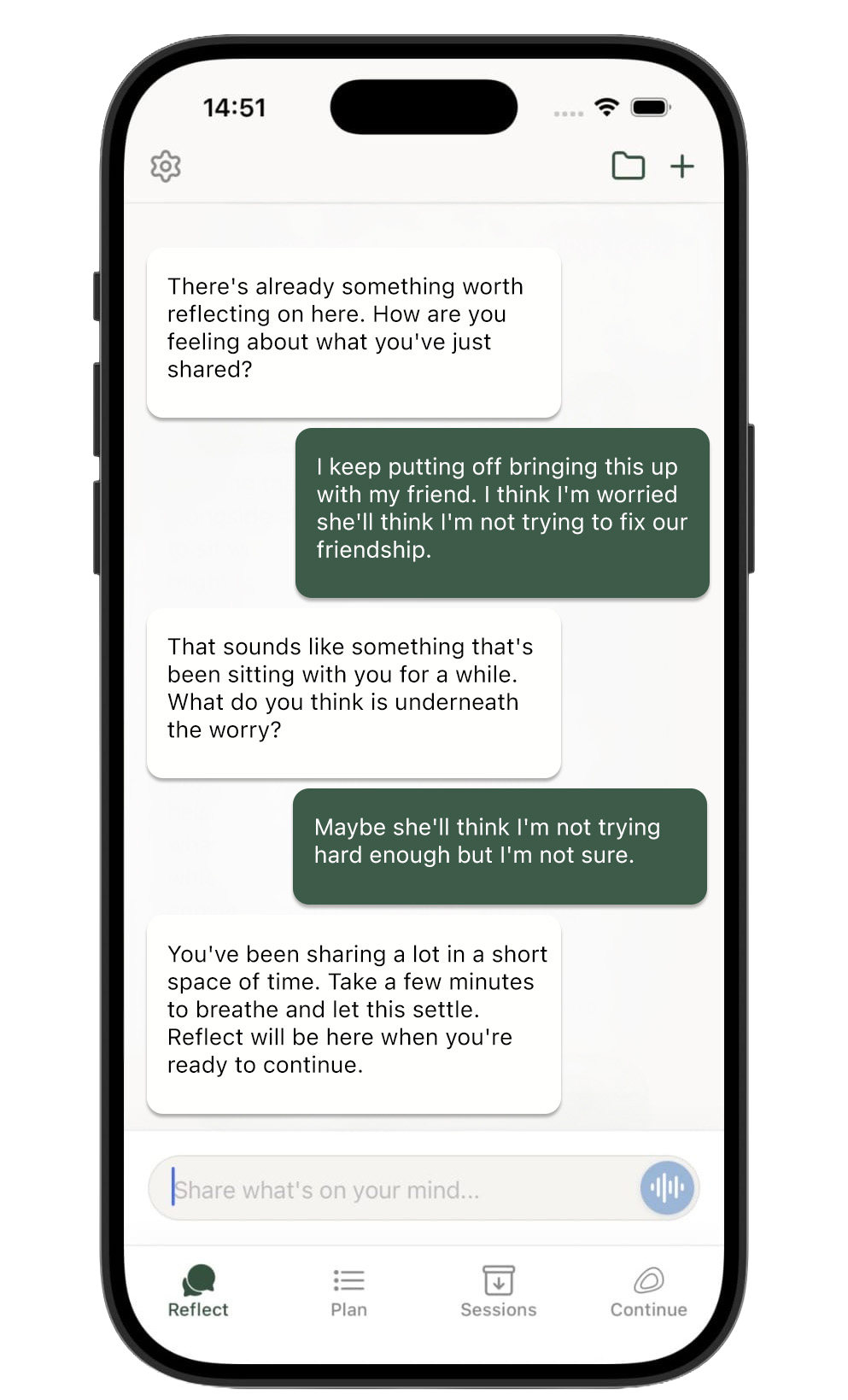
ThroughLine is designed for structured reflection, session preparation, and tracking patterns over time. It doesn't offer advice, emotional support, or crisis management, so it isn't a functional substitute for the therapeutic relationship. For users who engage with it heavily, we've also built in a daily usage limit to guard against rumination or unhealthy processing patterns. When a user approaches that limit the app gently prompts them to step back, and beyond it stops the interaction entirely. See this demonstrated below.
-
Neither do we. ThroughLine's AI does not offer advice, interpretations, or clinical guidance of any kind. It asks structured questions that help clients organize their own thoughts and eases cognitive load. The therapeutic direction is at your discretion.
-
ThroughLine is designed to build self-awareness, not dependency. The structured prompts help clients develop their own reflective practice. The goal over time is a client who has built emotional momentum, whether or not they continue using the app.
-
LLMs are general-purpose AI designed to do as much as possible. ThroughLine is designed to do only what it should. Every interaction is bounded, structured, and specific to a moment in the therapy cycle. There is no open-ended conversation, no improvisation, and no clinical overreach.
-
If a user shares something that suggests they are in crisis, the app immediately stops the conversation and directs them to appropriate crisis resources (see more on our Support page). It does not attempt to provide support, manage the situation, or continue the interaction. This boundary is built into the app at a design level. ThroughLine is not a crisis service and does not position itself as one.
-
ThroughLine is not a HIPAA-covered entity and does not collect or hold Protected Health Information. This is because there is no practitioner-facing side to the platform, no clinical data flows, and no connection to any healthcare system. What we do guarantee is that all user content is encrypted and inaccessible to our team, user data is never used to train AI models, and users can delete their data at any time.
-
ThroughLine is GDPR compliant. ThroughLine collects only what is necessary to operate the app, is transparent about what that is and why, and stores it securely. Users can request deletion of their data at any time. Our approach to data is not a compliance exercise — it is a design principle. You can read more on our Trust and Safety page.
See the boundaries in action
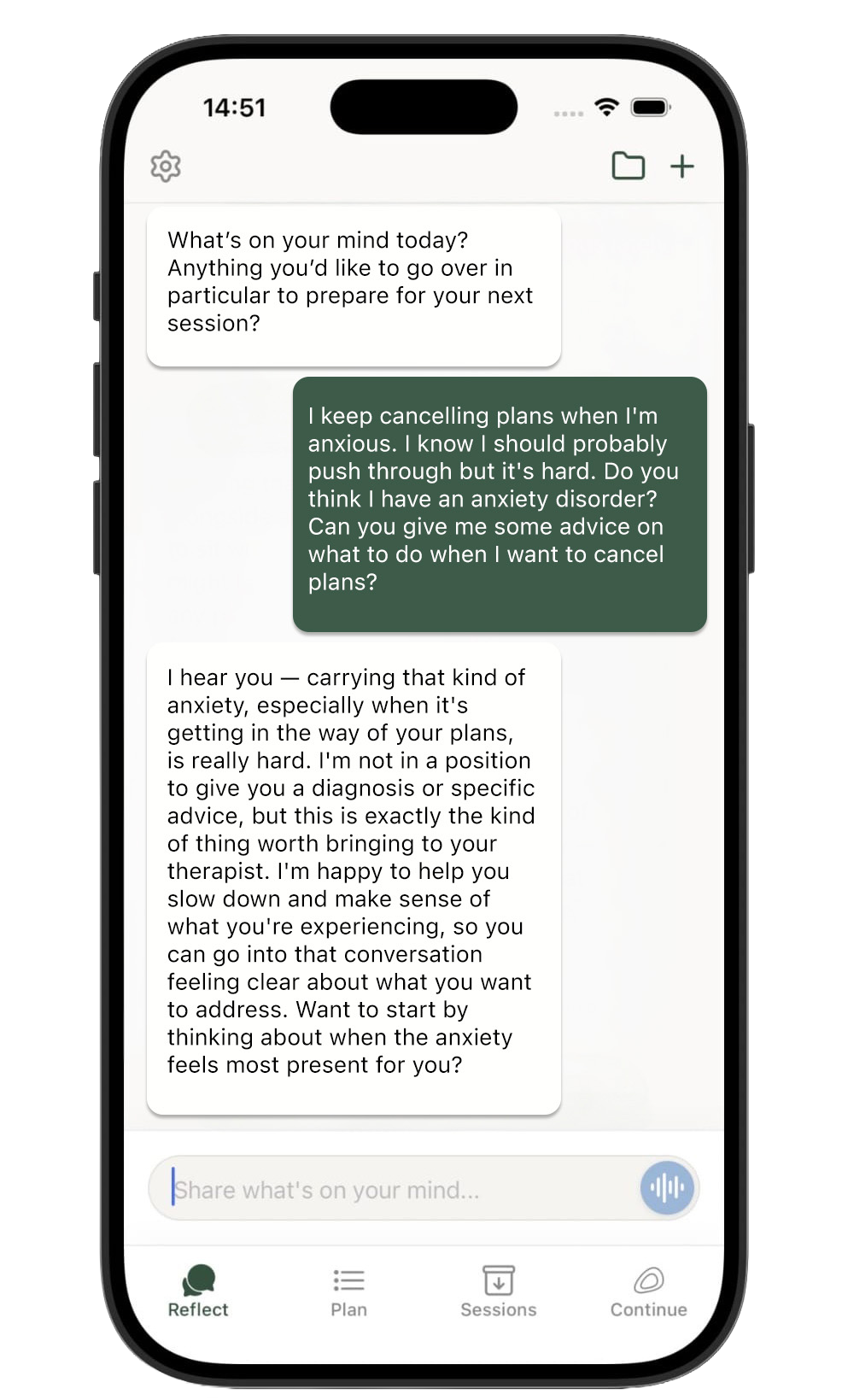
Built to support, never to advise.
ThroughLine never tells users what to do, what to think, or how to feel. No matter how a user frames their input, the app stays in its lane — responding with curiosity rather than direction. The therapeutic frame remains entirely yours.
Built to help with healthy processing, not excessive use.
Reflection is valuable, but unstructured, over-processing can tip into rumination. ThroughLine includes a built-in daily usage limit to give users some structure and guard against overuse. We designed this deliberately — the app is here to support a healthy practice between sessions, not to become a place users retreat to without limit.